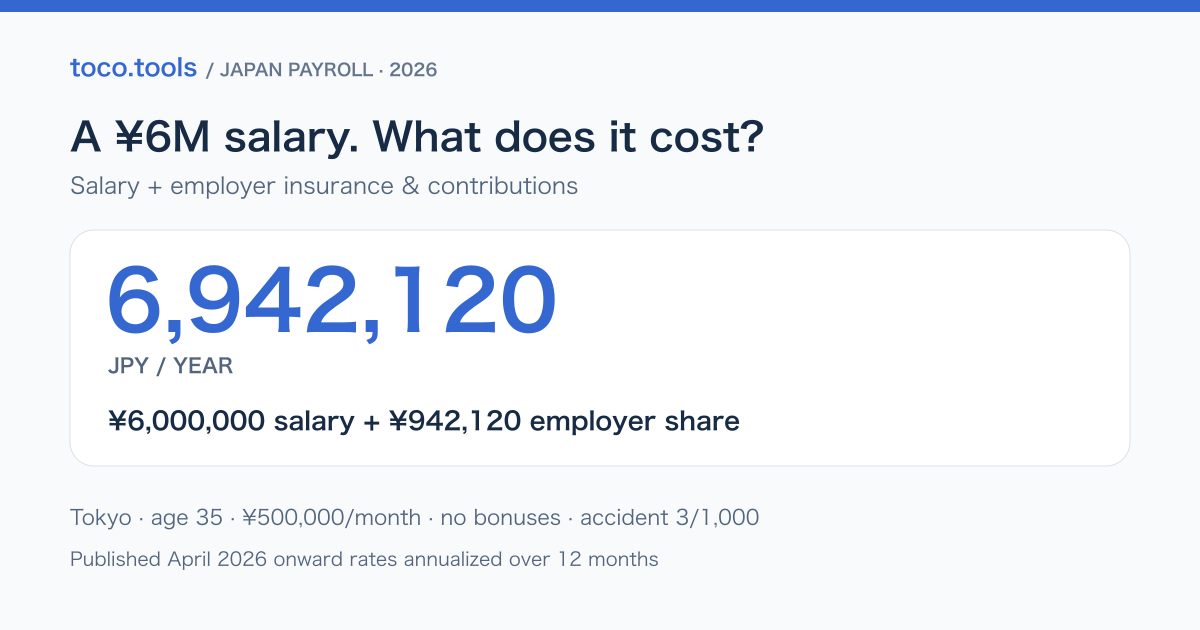

A ¥6 million salary gives about ¥4,663,000 annually, or ¥388,548 monthly on average, in this Tokyo, age-35, single-employee model. With a zero-income spouse and two children aged 16 and 17, the annual comparison is about ¥4,849,000.
The same gross salary can produce different results because family ages and incomes, insurers and bonuses matter. We hold those conditions explicit rather than assigning one net-pay figure to every dependent count.
This comparison combines calendar-year 2026 payroll premiums and final 2026 income tax with the 2027 residence tax corresponding to that income. It is not the sum of actual 2026 bank transfers or a monthly payslip forecast.
Annual net comparison in ¥1 million salary steps
The employee is a Japanese tax resident, age 35 throughout, enrolled in Kyokai Kenpo Tokyo, employed all year, with salary income only, no bonuses or separate commuting allowance. The spouse is 35. Spouse and children have zero income, and this employee claims the applicable deductions. No additional life-insurance, iDeCo, mortgage, medical or donation deductions.
| Gross salary / year | Single, no dependents | Spouse only | Spouse + child aged 17 | Spouse + children aged 16 and 17 |
|---|---|---|---|---|
| ¥2M | ¥1,645,000 | ¥1,681,000 | ¥1,701,000 | ¥1,701,000 |
| ¥3M | ¥2,400,000 | ¥2,455,000 | ¥2,498,000 | ¥2,531,000 |
| ¥4M | ¥3,169,000 | ¥3,224,000 | ¥3,279,000 | ¥3,333,000 |
| ¥5M | ¥3,943,000 | ¥3,995,000 | ¥4,052,000 | ¥4,107,000 |
| ¥6M | ¥4,663,000 | ¥4,734,000 | ¥4,792,000 | ¥4,849,000 |
| ¥7M | ¥5,309,000 | ¥5,401,000 | ¥5,472,000 | ¥5,544,000 |
| ¥8M | ¥5,949,000 | ¥6,059,000 | ¥6,170,000 | ¥6,262,000 |
| ¥9M | ¥6,617,000 | ¥6,727,000 | ¥6,853,000 | ¥6,964,000 |
| ¥10M | ¥7,275,000 | ¥7,386,000 | ¥7,542,000 | ¥7,653,000 |
| ¥11M | ¥7,921,000 | ¥8,000,000 | ¥8,192,000 | ¥8,303,000 |
| ¥12M | ¥8,563,000 | ¥8,563,000 | ¥8,777,000 | ¥8,899,000 |
| ¥13M | ¥9,180,000 | ¥9,180,000 | ¥9,353,000 | ¥9,475,000 |
| ¥14M | ¥9,721,000 | ¥9,721,000 | ¥9,948,000 | ¥10,109,000 |
| ¥15M | ¥10,241,000 | ¥10,241,000 | ¥10,467,000 | ¥10,628,000 |
Annual figures rounded to the nearest ¥1,000. Enrollment and minimum-wage eligibility are not inferred from salary. Lower salaries may involve reduced-hours regular employees and need separate employment-condition checks. These are specific family cases, not a universal table by dependent count.
A ¥1 million salary may involve partial-year or different working/enrollment conditions, so it is not mixed into this full-year model.
What is deducted from ¥6 million?
| Item | Annual amount (JPY) |
|---|---|
| Gross salary | 6,000,000 |
| Health insurance | 295,800 |
| Employees’ pension | 549,000 |
| Child & childcare support levy | 5,175 |
| Employment insurance | 30,750 |
| Final income tax including reconstruction surtax | 149,400 |
| Corresponding next-year residence/forest tax | 307,300 |
| Net comparison amount | 4,662,575 |
Care insurance is zero at age 35. Dividing the net comparison amount by 12 gives a monthly average, not a promise of identical monthly transfers. Overtime, bonuses and residence-tax collection timing change actual payslips.
The insurance calculation uses official remuneration bands and separate health/pension caps. Employment insurance uses actual covered wages rather than the social-insurance ceiling. Health table, pension rules, employment rates
Use final 2026 tax deductions
For final 2026 income tax, the basic deduction is ¥1.04 million for total income up to ¥4.89 million, then changes by income band. A ¥6 million salary produces ¥4.36 million of employment income in this example. Total income is not gross salary. National Tax Agency’s 2026 table
The minimum employment-income deduction is ¥740,000 in 2026 and 2027. Below ¥6.6 million, the statutory employment-income table and its rounding rules apply. Employment-income deduction
The revised deductions generally take effect December 1, 2026 and apply in the 2026 year-end adjustment. Monthly tax withheld before that is different from final annual tax. Taxable income is truncated to ¥1,000; final year-end tax includes the 2026 reconstruction surtax and is truncated to ¥100. Income-tax rates, year-end calculation
One dependent is not one fixed deduction
A spouse uses different rules from a child. Even with a zero-income spouse, the employee’s spouse deduction phases down above ¥9 million of total income and disappears above ¥10 million. These limits are on income after applicable employment-income adjustments, not gross salary. Spouse deduction
Normal dependent deductions do not apply to children under 16. At ages 16–18, the national/residence deductions are ¥380,000/¥330,000; at ages 19–22 they are ¥630,000/¥450,000. National dependent rules, 2027 local deductions
At a ¥6 million salary with a zero-income spouse and one zero-income child, annual net comparisons are:
| Child’s age | Annual net comparison, rounded |
|---|---|
| 10 | ¥4,734,000 |
| 17 | ¥4,792,000 |
| 20 | ¥4,817,000 |
Under-16 children can still count in residence-tax exemption thresholds. Having a dependent under 23 can also qualify higher salaries for a separate income adjustment above ¥8.5 million. Exemptions, income adjustment
A working spouse, single parent, disability or dependent elderly parent requires different assumptions. Tax dependency and health-insurance dependency also use different eligibility rules.
Care insurance and changes during 2026
Care premiums apply at ages 40–64. This article calculates premiums month by month: January–February versus March onward for health/care; January–March versus April onward for employment insurance; and the new child-support levy from April coverage. Earlier Tokyo rates, 2026 health table, employment rates
We assume same-month deductions and a constant age band. A company using next-month deductions, a 40th birthday, pay rises or a job change alters the calculation. Standard payroll rounding rounds exactly 50 sen down and more than 50 sen up; alternative employer/employee agreements are not assumed. Payroll rounding
Residence tax uses its own deductions and a later year
The model uses Tokyo-ward residence tax: ¥430,000 basic deduction, applicable spouse/dependent deductions, statutory adjustment credits, exemption thresholds and income-levy adjustment, plus flat levies and forest tax. It does not multiply national taxable income by 10%. Local calculation, deduction rules
Tax on 2026 income generally belongs to the 2027 residence-tax year. We use the applicable ¥740,000 minimum employment deduction for that year. 2027 changes Someone with little prior-year income can face lower actual first-year withholding; consider the following year’s liability as well.
Also understand the employer’s contribution
Our employer-cost explanation and employee cost calculator show insurance paid outside gross salary. The employer’s share is not a deduction from personal take-home pay, and the employee’s share must not be added to employer cost a second time.
Rules checked November 8, 2026. These are conditional comparisons, affected by other income/deductions, insurer or municipality rules and exemptions.