
Leaving Japan’s Small Enterprise Mutual Aid scheme before 20 years does not always mean receiving less than you contributed. Closing a business or actually resigning as an officer is different from continuing your work and cancelling only the mutual aid contract.
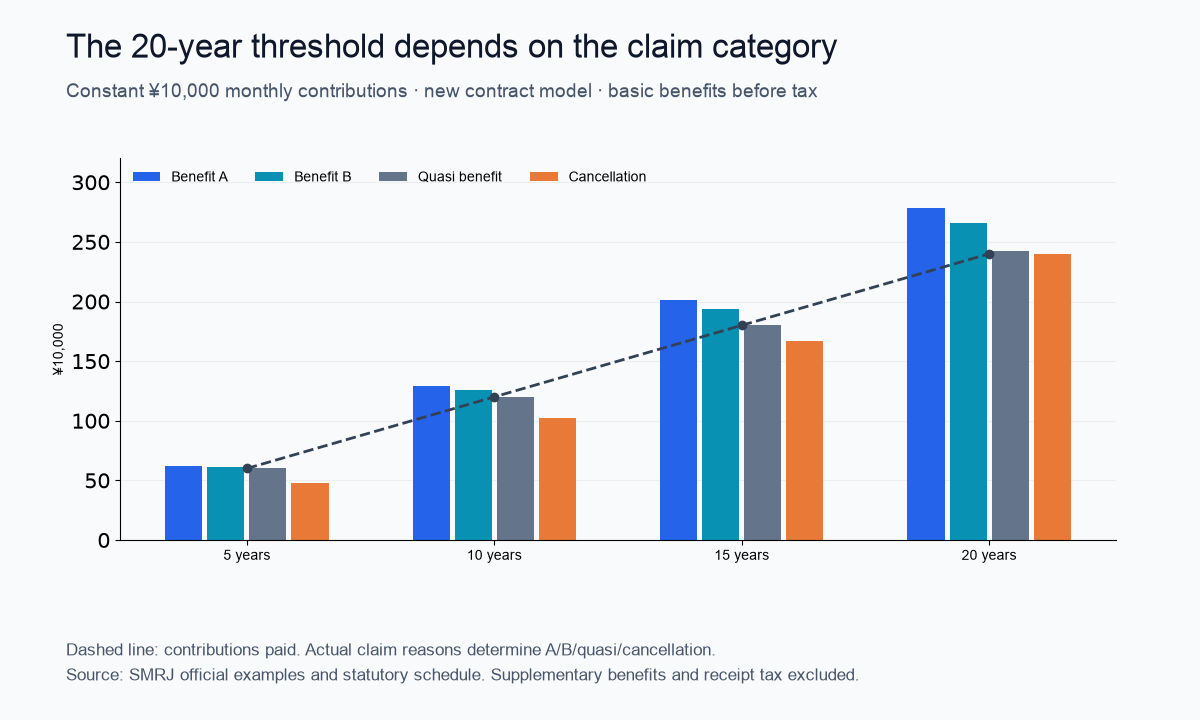
With unchanged ¥10,000 monthly payments for 10 years, total contributions are ¥1,200,000. The basic amounts are ¥1,290,600 for benefit A, ¥1,260,800 for benefit B and ¥1,200,000 for the quasi-benefit. Voluntary cancellation returns ¥1,020,000. The claim reason changes the result even when paid months are identical. SMRJ’s official examples
A, B and quasi-benefits are not options you can freely select by comparing their prices. Establish the actual claim event and your membership status first. A benefit exceeding contributions is also a gross comparison, not proof of an after-tax profit.
Official sources were checked on November 8, 2026. Numerical examples use the current rules for a new member, unchanged contributions and no missed payments. They do not reconstruct pre-April 2004 contributions, every transitional provision or earlier contract transfers. Japanese official guidance governs this Japanese scheme.
First identify what you are leaving
The four categories are benefit A, benefit B, quasi-benefit and cancellation payment. They correspond to statutory events rather than investment products you can switch between. Small Enterprise Mutual Aid Act, Articles 7, 9 and 12
| Question | Facts that change the category |
|---|---|
| What is your membership status? | Sole proprietor, registered co-manager of a sole proprietor’s business, or company officer |
| What actually ends? | All individual businesses, an officer/co-manager position, or just the mutual aid contract |
| What are your age, reason and paid months? | Age 65, resignation because of illness/injury, or the 180 paid months required for old-age benefits |
| Does incorporation or an older rule apply? | Eligibility after incorporation, joining date, event date and previous transfers |
Check the 20-year rule after resolving those questions. The following sections separate the three member statuses. Their tables show the basic categories; also check the deemed old-age treatment and older-contract exceptions explained below.
Sole proprietors: full business closure differs from cancelling while still working
| Category | Main events under the current rules |
|---|---|
| A | Closure of the individual business; the member’s death |
| B | Old-age benefit: age 65 or older and at least 180 paid months |
| Quasi-benefit | Incorporation causes loss of scheme eligibility |
| Cancellation payment | Voluntary cancellation; taking a payment after incorporation despite retaining eligibility; SMRJ cancellation for at least 12 months of unpaid contributions |
If you operate multiple individual businesses, all must cease for the full-closure A event. Closing one shop while another individual business continues does not establish that event. Incorporation is treated separately, so filing a business-closure notification does not by itself guarantee A. SMRJ’s claim-event guidance, Act, Articles 9 and 12
Old-age B can be claimed while continuing to work, but both age 65 and 180 paid months are required. Fifteen years alone is insufficient for someone younger than 65; reaching 65 alone is insufficient with fewer than 180 paid months. Official old-age conditions
Company officers: resignation before 65 is different from voluntary cancellation
| Category | Main events under the current rules |
|---|---|
| A | Dissolution of the company or other eligible entity, including company bankruptcy |
| B | Officer resignation because of illness/injury; resignation at 65 or older; the member’s death; old-age benefit |
| Quasi-benefit | Resignation before 65 without company dissolution or illness/injury |
| Cancellation payment | Voluntary cancellation while remaining an officer; SMRJ cancellation for at least 12 months of unpaid contributions |
For example, an officer who resigns at 60 for a reason other than illness or injury, while the company continues, falls under the current quasi-benefit category. That differs from staying an officer and cancelling the contract. Company dissolution is A; resigning individually does not by itself make it A. Act, Articles 7(4) and 9, SMRJ’s officer explanation
Officer resignation at age 65 or older does not require the 180 paid months needed for old-age B. It does require the six-month minimum for A/B payments. Claiming B while remaining an officer through the old-age route requires both age 65 and 180 paid months. Illness/injury resignation must also be supported by the relevant documents; simply having a diagnosis does not establish every claim condition. Act, Article 9(1), Official resignation procedure
Co-managers: do not copy the officer resignation rules
Here, a co-manager means someone enrolled in that status while managing a sole proprietor’s business together with the proprietor. This is a different membership status from a company director.
| Category | Main events under the current rules |
|---|---|
| A | Leaving because the proprietor closes all individual businesses; leaving because of illness/injury; the member’s death |
| B | Old-age benefit: age 65 or older and at least 180 paid months |
| Quasi-benefit | The proprietor’s incorporation causes loss of eligibility |
| Cancellation payment | Voluntary cancellation or voluntary departure without old-age eligibility; payment after incorporation while retaining eligibility; SMRJ cancellation |
Illness/injury departure is A for a co-manager, compared with B for a company officer. Voluntarily leaving for another job or an independent business does not become a quasi-benefit simply because an officer’s resignation before 65 can qualify for that category. SMRJ’s co-manager claim events
If voluntarily leaving before 65 or with fewer than 180 paid months, the payment is a cancellation payment. SMRJ’s FAQ identifies B when the departing co-manager is at least 65 with at least 180 paid months. Age 65 alone is therefore insufficient for this co-manager route. Official voluntary-departure conditions, SMRJ’s age/months FAQ
Check deemed old-age treatment at 65 with 180 paid months
Some events normally leading to quasi-benefits or cancellation payments, including incorporation and voluntary cancellation, can instead support a B claim when the member is at least 65 with at least 180 paid months at the event date. SMRJ calls this deemed old-age treatment; its FAQ also includes cancellation by SMRJ for arrears. SMRJ’s deemed old-age FAQ
Do not conclude that every incorporation must be quasi-benefit or every request to cancel must be a cancellation payment without checking age and paid months. Incorporation has older-member exceptions too. Confirm the applicable procedure: this treatment is available to people satisfying the old-age conditions, not an unrestricted option to switch into A or B.
Official examples: ¥10,000 monthly for 5, 10, 15 and 20 years
All amounts below are gross JPY. Contributions stay unchanged and are paid for every month. A, B and quasi-benefits show only the basic amounts, excluding supplementary benefits. Cancellation payments receive no supplementary addition. Receipt taxes and settlement of unpaid contributions or outstanding loans are excluded. Basic-benefit calculation, Cancellation calculation
| Paid period | Contributions | A | B | Quasi-benefit | Voluntary cancellation |
|---|---|---|---|---|---|
| 5 years(60 months) | 600,000 | 621,400 | 614,600 | 600,000 | 480,000 |
| 10 years(120 months) | 1,200,000 | 1,290,600 | 1,260,800 | 1,200,000 | 1,020,000 |
| 15 years(180 months) | 1,800,000 | 2,011,000 | 1,940,400 | 1,800,000 | 1,665,000 |
| 20 years(240 months) | 2,400,000 | 2,786,400 | 2,658,800 | 2,419,500 | 2,400,000 |
These reproduce SMRJ’s four official examples and were checked with our engine using Cabinet Order Tables 1 and 2. Each column shows a different claim category, not an unrestricted choice for the same member. For example, five years cannot qualify for old-age B; that B amount requires another applicable event, such as eligible officer resignation.
The same 10 years can produce different outcomes
At ¥10,000 for 120 paid months, contributions total ¥1,200,000. Applying the current categories to actual events gives these examples:
- A sole proprietor closes all individual businesses: A is ¥1,290,600, or ¥90,600 above contributions.
- An officer resigns before 65 for a reason other than illness/injury: quasi-benefit is ¥1,200,000, equal to contributions.
- An officer resigns at 65 or older: B is ¥1,260,800, or ¥60,800 above contributions. The officer-resignation B event does not need 180 paid months.
- A member without old-age eligibility keeps working but voluntarily cancels: ¥1,020,000, or ¥180,000 below contributions.
These exclude supplementary benefits and taxes. Check whether the real event satisfies the official claim conditions. In this comparison, the ¥180,000 gross shortfall belongs to voluntary cancellation rather than every exit before 20 years.
Short memberships: six- and twelve-month minimums still matter
Being able to receive a payment before 20 years does not mean every contribution can be recovered immediately after joining.
| Category | Minimum paid months for payment |
|---|---|
| A/B | Six months; no payment with fewer than six |
| Quasi-benefit/cancellation | Twelve months; no payment with fewer than twelve |
Even if the claim event occurs, a membership below its minimum returns no contribution payment. Act, Articles 9 and 12. At unchanged ¥10,000 monthly:
| Paid months | Contributions, JPY | A, JPY | B, JPY | Quasi, JPY | Cancellation, JPY |
|---|---|---|---|---|---|
| 5 | 50,000 | 0 | 0 | 0 | 0 |
| 6 | 60,000 | 60,000 | 60,000 | 0 | 0 |
| 11 | 110,000 | 110,000 | 110,000 | 0 | 0 |
| 12 | 120,000 | 120,000 | 120,000 | 120,000 | 96,000 |
For a qualifying full-closure A event after six paid months, the basic amount is ¥60,000, equal to contributions. Voluntary cancellation at eleven paid months returns zero against ¥110,000 paid. “Every short exit returns 80%” is also incorrect.
A/B amounts do not accrue like a constant-rate deposit
Under the current Act, a contribution segment with fewer than 36 paid months returns its paid amount for A/B, subject to the overall minimum. Statutory table amounts apply from 36 months. At ¥10,000 monthly, both A/B are ¥350,000 at 35 months; at 36 months A is ¥367,400 and B is ¥365,000. Act, Article 9(3), Order, Table 1
Quasi-benefits also have a statutory contribution floor. Their equality with contributions at 5, 10 and 15 years in the official examples does not imply equality after receipt taxes. Act, Article 12(4)
The voluntary cancellation threshold is 240 paid months
With unchanged contributions under the current model, the cancellation rate reaches 100% at 240 paid months. At 239 months it is 99.25%. Order, Table 2
| Paid months | Contributions, JPY | Rate | Cancellation, JPY | Difference, JPY |
|---|---|---|---|---|
| 239 | 2,390,000 | 99.25% | 2,372,075 | -17,925 |
| 240 | 2,400,000 | 100% | 2,400,000 | 0 |
This does not permit changing the real claim event to obtain a preferred amount or continuing a contract after closure/resignation without the required procedure. Count actual paid months rather than simply elapsed calendar years.
Twenty years of membership is not twenty paid years for a later increase
Contributions are divided into ¥500 monthly segments, each with its own paid-month count. A later increase has a shorter history, so cancellation can return less than total contributions even after a 20-year membership. A history including reductions also needs segment-by-segment review. SMRJ’s contribution-change calculation
Consider ¥10,000 monthly for the first ten years, increasing to ¥70,000 for the next ten, followed by voluntary cancellation:
| Segment | Paid months | Contributions | Cancellation payment |
|---|---|---|---|
| Original ¥10,000 monthly | 240 | ¥2,400,000 | ¥2,400,000 at 100% |
| Additional ¥60,000 starting ten years later | 120 | ¥7,200,000 | ¥6,120,000 at 85% |
| Total | Membership lasts 20 years | ¥9,600,000 | ¥8,520,000 |
The gross shortfall is ¥1,080,000. This combines current statutory segment rates and excludes taxes and previous tax relief. Check every segment’s paid period before treating 20 years as a principal guarantee.
Incorporation does not automatically qualify as A
For someone joining under current rules as a sole proprietor or co-manager, establish the new status and eligibility after incorporation. The following basic categories assume the old-age treatment discussed above does not apply:
| Position after incorporation | Basic current treatment |
|---|---|
| Scheme eligibility is lost | Quasi-benefit |
| Eligibility remains, such as an eligible small-company officer, but a payment is taken | Cancellation payment |
| Eligibility remains and the member wants continuation without taking a payment | A same-person paid-month transfer may be available, subject to its conditions |
Starting a company alone does not establish A. SMRJ’s incorporation procedure, Act, Articles 7 and 12
A same-person transfer preserves paid months through a prescribed procedure without receiving the old contract’s benefits. New membership eligibility and other conditions apply, with the statutory period generally within one year of the event. It is not a way to freely reverse a completed payment. Check before claiming, including when starting a different eligible business after closure/resignation. Act, Article 13, SMRJ’s new-business FAQ
Older contracts: joining dates and event dates are different
Older explanations may describe different rules. Keep these boundaries separate:
| Boundary | What to check |
|---|---|
| Current examples from April 2004 onward | Contributions before April 2004 can have different treatment |
| Joining in December 2010 or earlier | All-cash incorporation by that sole proprietor can qualify for an A exception where the current treatment would be quasi-benefit or cancellation; transfer history also matters |
| Events in March 2016 or earlier | Full business transfers to a spouse/child and related departures can fall under quasi-benefits; officer resignation other than illness/injury was quasi-benefit even at 65 or older |
The 2016 distinction concerns when the transfer or resignation occurred, not simply whether membership began before 2016. It is separate from the joining-date exception around 2011. This article does not reconstruct all transitional rules. Notes in SMRJ’s current claim table, Official handbook, Older-contribution warning
Gross shortfall, after-tax cash and tax-inclusive results are separate
Full contribution deductibility does not mean every contributed yen is refunded as tax. Actual relief depends on taxable income and applicable rates, among other facts. National Tax Agency contribution-deduction guidance
| Measure | What it compares |
|---|---|
| This article’s contribution difference | Gross basic benefit or cancellation payment minus total paid contributions |
| Cash actually received | Actual benefit less receipt taxes and settlement of outstanding loans or other deductions |
| Result including tax relief | Contribution outflows, actual historical tax relief, receipt taxes and any borrowing interest across the entire period |
A ¥180,000 gross shortfall after ten years of voluntary cancellation does not establish an overall loss after historical tax relief. Conversely, little taxable income, receipt taxes or borrowing costs can change that result. Do not add tax relief again if the comparison already uses contributions net of that relief.
A payment equal to contributions is not necessarily tax-free. Lump-sum versus installment treatment, age on voluntary cancellation and other retirement payments can affect taxation. SMRJ’s receipt-tax guidance. Read the conditions and worked examples in our mutual aid receipt-tax article.
Five checks before cancelling
- Identify membership status and the real event. Separate full business closure, officer resignation, co-manager departure and contract-only cancellation; establish the date.
- Check age and actual paid months. The six-/twelve-month minimums, age 65 plus 180-month old-age conditions and 240-month cancellation threshold are different tests.
- Collect the contribution-change history. Today’s monthly contribution multiplied by membership years cannot reconstruct all earlier payments or cancellation benefits.
- Separate gross entitlement from actual cash. Review basic benefits, supplementary benefits, receipt taxes and outstanding-loan settlements separately.
- Check reduction or transfer eligibility before claiming. Continuing businesses may reduce contributions to ¥1,000 monthly, but reduction does not erase previous segments’ shortfalls automatically. Continuation after a claim event requires checking the relevant transfer procedure. SMRJ’s payment-difficulty FAQ, Transfer FAQ
Use the Small Enterprise Mutual Aid simulator to compare A, B, quasi-benefits and voluntary cancellation under unchanged contributions. For example, enter ¥10,000 monthly for 10 years, then compare 20 years. The current tool does not reconstruct a personal contribution-change history, older transitional rules or receipt taxes. Confirm the actual claim category and entitlement with SMRJ.
For the decision to continue alongside investing, see our 20-year NISA comparison. For year-end payment timing, read prepayments, 13 months and the ¥1.68 million deduction example.