
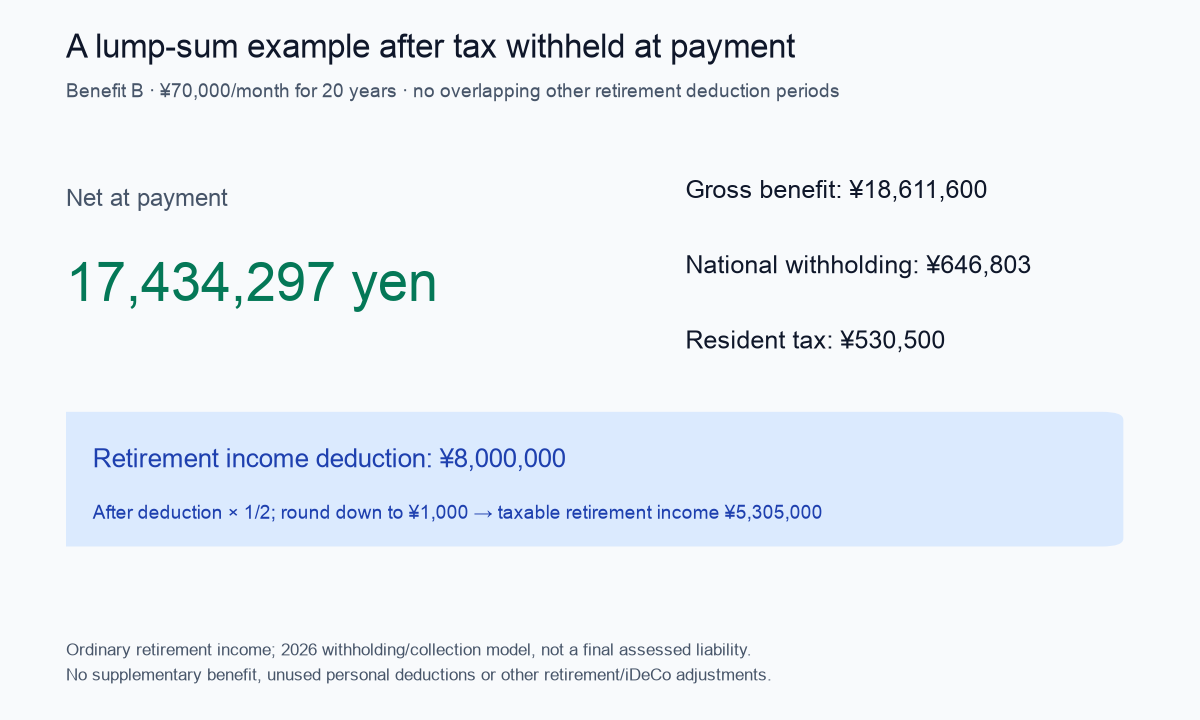
In a 20-year example paying ¥70,000 a month, Benefit B falls from ¥18.61 million gross to approximately ¥17.43 million after tax at payment. This assumes an ordinary lump-sum claim without overlapping retirement deductions. Deductible contributions do not make every withdrawal tax-free.
If annual contribution-stage tax savings are held at ¥241,300, the model's nominal advantage over total contributions is approximately ¥5.46 million after receipt tax. Income, tax law and eligibility are held constant for illustration. Other retirement payments, iDeCo and pension income can change the result.
Official sources were checked on November 8, 2026. This article covers ordinary payments to a Japanese tax resident. Annual assessed tax, withholding and local tax are distinguished throughout.
Identify the income category first
| Claim or payment | Tax category | Starting point |
|---|---|---|
| Non-death Benefit A/B or quasi-benefit, paid as a lump sum | Retirement income | Retirement deduction; ordinarily half the excess |
| Benefit A/B paid in instalments | Miscellaneous income from public pensions, etc. | Combine qualifying pension receipts for the year |
| Combined lump sum and instalments | Retirement income for the lump sum; pension income for instalments | Calculate each component separately |
| Voluntary cancellation or voluntary withdrawal as a joint manager, age 65+ at the relevant event | Retirement income | Retirement deduction |
| The same events before age 65 | Occasional income (ichiji shotoku) | Annual special deduction up to ¥500,000 |
| A cancellation allowance after SMRJ cancellation for at least 12 unpaid months | Occasional income | Separate from voluntary cancellation at 65+ |
| Cancellation after incorporation while membership eligibility remains | Retirement income | An exception to ordinary voluntary cancellation treatment |
| A survivor receives a death benefit | Deemed inherited property | Outside this income-tax example |
See SMRJ's official classification. For the events covered by FAQ370, voluntary cancellation uses the acceptance date; joint-manager withdrawal uses the withdrawal date. Age and the tax year are not freely changed by delaying the bank transfer. Historical events or old contracts can require different treatment.
Check deemed old-age benefit eligibility before taking a cancellation allowance. For listed events including incorporation, voluntary cancellation and SMRJ cancellation, age 65+ and 180 paid months at the event can permit a Benefit B claim instead of the usual quasi-benefit/cancellation allowance. That B is retirement income as a lump sum or pension miscellaneous income in instalments. The occasional-income row above describes payment as a cancellation allowance. SMRJ FAQ225, tax treatment for a deemed old-age claim
Illness-related resignation, retirement directly caused by disability, and death are distinct cases. The calculations here exclude inheritance tax, death during instalments, and the additional retirement deduction for qualifying disability. SMRJ claim guide, NTA disability note
How the ordinary lump-sum calculation works
The retirement deduction
| Tax service period | Deduction |
|---|---|
| Up to 20 years | ¥400,000 per year, minimum ¥800,000 |
| Over 20 years | ¥8 million + ¥700,000 per year above 20 |
A partial year is rounded up: exactly 20 years gives ¥8 million; 20 years and one month gives 21 years and ¥8.7 million. NTA retirement-tax overview
For this scheme, check the tax period from the mutual-aid contract's establishment to the relevant claim event. It is not simply the number of years worked at a company. An approved contribution-suspension period does not count toward this deduction. Transfers, unpaid contributions or interrupted history need an individual check. SMRJ claim guide, FAQ80 on suspension
For ordinary retirement income, subtract the deduction, take half the remaining amount, and round the taxable amount down to the nearest ¥1,000. Apply the retirement-income tax table and the applicable national surtax. The calculation is generally separate from salary and business income. NTA No.1420, retirement withholding table
The half-income rule has exceptions
- Specified officer retirement payments: the part corresponding to officer service of five years or less receives no half-income treatment. This restriction applies from the 2013 tax year. NTA No.2737, official implementation Q&A
- Short-service retirement payments: for qualifying service of five years or less outside the specified-officer category, the excess over ¥3 million after the retirement deduction is not halved. This applies to payments due on or after January 1, 2022. NTA No.2740
The main example has a 20-year period. Do not copy its formula to a short-service payment or assume company officer service and mutual-aid membership are identical. Different categories received in the same year can require a combined calculation.
Worked example: ¥70,000 a month for 20 years
Assume a sole proprietor claims old-age Benefit B as a lump sum at age 65 after 240 paid months. The category follows the actual claim event; A and B are not interchangeable choices. Old-age benefit eligibility includes age 65+ and at least 180 paid months. SMRJ claim categories
Contributions are unchanged, without suspension, arrears or transferred periods. Additional benefits and outstanding loans are excluded. There are no other retirement payments or overlapping iDeCo deductions. The retirement-income declaration is submitted. We calculate 2026 withholding and resident tax at payment, without a subsequent refund for unused personal deductions or tax credits.
| Item | Calculation / yen |
|---|---|
| Total contributions | 70,000 × 12 × 20 = 16,800,000 |
| Gross Benefit B | 18,611,600 |
| Retirement deduction | 400,000 × 20 = 8,000,000 |
| Half the excess | (18,611,600 − 8,000,000) ÷ 2 = 5,305,800 |
| Taxable retirement income | Round down to 5,305,000 |
| Base national income tax | 5,305,000 × 20% − 427,500 = 633,500 |
| National withholding including reconstruction surtax | 633,500 × 102.1% = 646,803.5 → 646,803 |
| Municipal / special-ward resident tax | 5,305,000 × 6% = 318,300 |
| Prefectural / metropolitan resident tax | 5,305,000 × 4% = 212,200 |
| Tax withheld/collected at payment | 1,177,303 |
| Net amount at payment | 17,434,297 |
The official basic-benefit table gives ¥132,940 for 240 months at a monthly contribution of ¥500. Multiplying by 140 units produces ¥18,611,600. SMRJ member handbook, Schedule 1. National withholding is rounded down to whole yen. Municipal and prefectural taxes are separately rounded down to ¥100. NTA calculation rules, Okayama City's retirement-tax calculation
Including contribution-stage savings: a nominal ¥5.46 million advantage
The companion NISA comparison assumes taxable income before the mutual-aid deduction of ¥4 million for national income tax and separately for resident tax. The ¥840,000 annual contribution produces a modeled annual tax reduction of ¥241,300, using the income-tax schedule and annual return rounding. A deduction is not a refund of every yen contributed.
| Fixed 20-year model | Yen |
|---|---|
| Total contributions | 16,800,000 |
| Annual savings × 20 | 4,826,000 |
| Nominal household cost after those savings | 11,974,000 |
| Net receipt at payment | 17,434,297 |
| Difference above that household cost | +5,460,297 |
That is ¥17,434,297 + ¥4,826,000 − ¥16,800,000 = ¥5,460,297. Receipt tax reduces the advantage by ¥1,177,303. If contribution-stage savings already reduced household cost in an equal-cost NISA comparison, adding those savings again would count them twice.
This fixes income and tax rules for 20 years; it is neither a reconstruction of past tax bills nor a forecast. It excludes reinvesting savings, opportunity cost, inflation and the timing delay in resident-tax savings.
Net payment versus final assessed tax
A low-income retirement year with unused personal deductions can allow a national income-tax refund after filing. Joyo City's explanation. Missing information about other retirement payments can instead require more tax.
Without a Retirement Income Declaration, national tax is withheld at 20.42% of the gross payment. This is not the final rate on taxable retirement income and does not include resident tax. A return reconciles the withholding. Submit the declaration to the payer before payment and include earlier same-year retirement withholding certificates. NTA declaration procedure, reconciliation
Instalments share the pension deduction with other pensions
Qualifying national and employees' pensions, company pensions, mutual-aid instalments and iDeCo pension payments are aggregated for the year's public-pension deduction. It is not a separate ¥1.1 million allowance for each provider. iDeCo pensions use the pension deduction; iDeCo lump sums use the retirement deduction. NTA No.1600, MHLW iDeCo tax treatment
Age and non-pension income change the deduction
Use age at December 31 of the income-tax year. The following deductions apply in the stated lower pension-receipt bands:
| Age / annual qualifying pension receipts | Other total income ≤¥10m | >¥10m to ¥20m | >¥20m |
|---|---|---|---|
| Under 65; pension receipts ≤¥1.3m | ¥600,000 | ¥500,000 | ¥400,000 |
| Age 65+; pension receipts ≤¥3.3m | ¥1,100,000 | ¥1,000,000 | ¥900,000 |
The deduction is not necessarily that fixed amount above these receipt bands. Pension miscellaneous income cannot fall below zero. NTA pension table, Minato City's detailed table
When non-pension total income is no more than ¥10 million, the higher bands are:
| Annual pension receipts R | Pension miscellaneous income |
|---|---|
| Under 65: >¥1.3m to ¥4.1m; age 65+: >¥3.3m to ¥4.1m | R × 75% − ¥275,000 |
| >¥4.1m to ¥7.7m | R × 85% − ¥685,000 |
| >¥7.7m to ¥10m | R × 95% − ¥1,455,000 |
| >¥10m | R − ¥1,955,000 |
For these bands, add ¥100,000 to the calculated income if non-pension total income is above ¥10 million and at most ¥20 million; add ¥200,000 if above ¥20 million. “Other income” means the relevant tax-law total, not gross salary or business sales. Official calculation table
Existing pensions of ¥2.4m plus ¥1m of mutual-aid instalments
Assume age 65+, no non-pension income, and ¥2.4 million of existing annual qualifying pensions. Add a hypothetical ¥1 million annual mutual-aid instalment. This amount illustrates deduction sharing; it is not the earlier Benefit B divided by a chosen payment term.
| Situation | Total pension receipts | Pension miscellaneous income |
|---|---|---|
| Existing pensions only | ¥2,400,000 | ¥1,300,000 |
| Plus mutual-aid instalments | ¥3,400,000 | ¥2,275,000 |
| Increase | ¥1,000,000 | ¥975,000 |
The combined calculation is ¥3,400,000 × 75% − ¥275,000 = ¥2,275,000. Looking only at the ¥1 million instalment and applying another ¥1.1 million deduction would be wrong. The ¥2.275 million is income before basic and other personal deductions, not the tax bill.
The 2026 and 2027 basic deductions use the same revised schedule
The 2026 reform supersedes descriptions based solely on the 2025 reform's planned reduction from 2027. For a resident's annual income-tax assessment:
| Total income | 2026 | 2027 |
|---|---|---|
| ≤¥4.89m | ¥1,040,000 | ¥1,040,000 |
| >¥4.89m to ¥6.55m | ¥670,000 | ¥670,000 |
| >¥6.55m to ¥23.5m | ¥620,000 | ¥620,000 |
| >¥23.5m to ¥24m | ¥480,000 | ¥480,000 |
| >¥24m to ¥24.5m | ¥320,000 | ¥320,000 |
| >¥24.5m to ¥25m | ¥160,000 | ¥160,000 |
| >¥25m | Zero | Zero |
The 2026 change takes effect on December 1, 2026 and applies to 2026 annual income tax. Death/departure returns filed before December 1 have transitional treatment. Some bands change from 2028. NTA No.1199, 2026 implementation Q&A
For example, age 65+ with only ¥2.1 million of qualifying pensions produces ¥1 million of pension income. The ¥1.04 million national basic deduction alone eliminates taxable national income under these 2026 assumptions. Resident tax is separate: its basic deduction is ordinarily ¥430,000 for total income up to ¥24 million. Exemption thresholds, adjustment credits and fixed levies require separate checks. Komae City's resident deductions, Taito: no basic-deduction change for resident tax
From 2027, the national surtaxes become reconstruction surtax of 1.1% plus defense surtax of 1%, totaling the same 2.1% of the relevant income-tax amount. This is not 2.1% of gross pension receipts. NTA pension taxation
Instalment withholding is also a prepayment
SMRJ's claim guide specifies withholding of 7.6575% of each mutual-aid instalment. That does not establish the final annual tax rate. SMRJ guide. Filing aggregates income and deductions. A filing exemption can apply when qualifying pensions total no more than ¥4 million and other income no more than ¥200,000, subject to its conditions. Refund claims and local resident-tax filing are separate questions. NTA No.1600
Instalments are available only for eligible non-death Benefit A/B claims, normally with age 60+ at the event and at least ¥3 million assigned to instalments. Combined payments require at least ¥300,000 as a lump sum and ¥3 million in instalments, totaling at least ¥3.3 million. Quasi-benefits and cancellation payments do not offer this choice. Check payment amounts, terms and later-change restrictions before claiming. SMRJ payment options
Combining mutual aid, company retirement payments and iDeCo
Same-year payments do not automatically get independent deductions
A later payer includes earlier same-year retirement payments and their tax information. Service periods are coordinated rather than simply assigning a full separate deduction to each benefit. The calculation uses the longest period and relevant non-overlapping periods. Provide the earlier withholding certificate. NTA No.2735
If company service and the mutual-aid period completely overlap for 20 years, do not assume two separate ¥8 million deductions totaling ¥16 million. iDeCo's deduction period generally reflects months of contributions, not merely investment-only years. Official iDeCo FAQ
Different years: the four-, nine- and nineteen-year lookbacks
The following outlines the main rules, excluding special cases such as a benefit calculated using previously combined service. Check both the relevant calendar years and overlapping calculation periods.
| Payment received later | Main lookback to earlier calendar years |
|---|---|
| Ordinary company/mutual-aid retirement lump sum after another ordinary retirement payment | Previous four years |
| Company/mutual-aid lump sum after an iDeCo/DC old-age lump sum received on or after January 1, 2026 | Previous nine years |
| iDeCo/DC old-age lump sum after company/mutual-aid retirement payments | Previous nineteen years |
The popular “10-year rule” means a nine-prior-calendar-year lookback; the “20-year rule” means nineteen prior calendar years. Pre-2026 DC payments do not all become subject to the nine-year window. Check the new and old payment categories in NTA No.2732, section 2(2) and the 2026 declaration instructions.
SMRJ's January 2026 A151 update also requests certificates for other retirement payments in the claim-event year or previous four years, and DC old-age lump sums received from 2026 in that year or previous nine years. Official SMRJ amendment
A 2026 iDeCo old-age lump sum followed by a 2035 mutual-aid tax year is nine years earlier and within the window; 2036 is outside that particular window. In reverse order, mutual aid in 2026 followed by iDeCo in 2045 is nineteen years earlier; 2046 is outside that window. These are calendar examples, not assurances that benefits can actually be postponed to those years or that doing so saves tax.
No overlap does not produce the same adjustment as full overlap. An earlier payment below its then-applicable deduction can use a deemed period based on that payment's amount. Partial years in overlap periods are rounded down, unlike the ordinary service-year roundup. Previously combined service has further rules. A “wait 10/20 years and always save” recommendation would therefore be unreliable. NTA adjustment rules
Voluntary cancellation before 65 can be taxable despite a contribution shortfall
For occasional income, the retirement deduction does not apply. With no other occasional income or qualifying expenses, the amount added to aggregate income is half of the positive remainder after subtracting the annual ¥500,000 special deduction from the cancellation payment.
Past mutual-aid contributions cannot be deducted as the cost of generating this occasional income. Do not use the treatment of a life-insurance maturity payment as a substitute. SMRJ FAQ262. The ¥500,000 special deduction is shared with other occasional income in the year. NTA No.1490
For a ¥4 million cancellation payment under these assumptions: (¥4 million − ¥500,000) ÷ 2 = ¥1.75 million is added to aggregate income. That is not ¥1.75 million of tax. Salary/business income, personal deductions, progressive national rates and resident tax determine the final liability. Receiving less than total contributions does not by itself make tax zero.
Build a payment timeline before choosing
- Confirm the claim event, event date, age and tax year. Distinguish closure, old-age benefit and voluntary cancellation.
- List mutual aid, company retirement benefits and iDeCo together, including amounts, service/contract/contribution periods and earlier withholding certificates.
- Calculate lump-sum overlap and aggregate pension receipts separately, then apply the relevant personal deductions.
- Separate tax withheld at payment from assessed tax. Ask the municipality about national health/care insurance effects; the article's amounts exclude insurance-premium changes.
Use the Small Business Mutual Aid calculator for contribution and benefit estimates, checking whether a displayed amount includes receipt tax. For individual tax and overlapping periods, bring the timeline to the NTA consultation service; for claim eligibility, contract history and payment options, use SMRJ's contact service.