
A ¥6 million gross salary does not represent the whole cost of hiring an employee in Japan. For Tokyo, age 35, ¥500,000 monthly pay and no bonuses, this model adds ¥942,120 of employer insurance and statutory contributions: total annualized cost ¥6,942,120.
Employees can use the same breakdown to understand the pension and insurance paid by their employer as well as deductions from their own salary.
The ¥6 million example
Assumptions: Kyokai Kenpo Tokyo branch; age 35 throughout; ¥500,000 monthly, no bonus or separate allowances; general-business employment insurance; workers’ accident category 94 at 3/1,000. Both standard monthly remuneration bases are ¥500,000. Published rates from April 2026 onward are held constant for 12 months. This is a hiring-budget comparison, not actual calendar-year 2026 payroll. Official remuneration table, employment rates, accident rates
| Insurance / contribution | Employer / year (JPY) | Employee / year (JPY) |
|---|---|---|
| Health insurance | 295,500 | 295,500 |
| Employees’ pension | 549,000 | 549,000 |
| Long-term care insurance | 0 | 0 |
| Child & childcare support levy | 6,900 | 6,900 |
| Child & childcare contribution | 21,600 | 0 |
| Employment insurance | 51,000 | 30,000 |
| Workers’ accident insurance | 18,000 | 0 |
| Asbestos relief contribution | 120 | 0 |
| Total | 942,120 | 881,400 |
Employer cost = gross pay and bonuses + employer contributions. The employee’s ¥881,400 is already inside the ¥6 million salary. Adding it again would double-count it. Income and residence taxes are not in this table; subtracting only insurance does not produce take-home pay.
The ¥120 asbestos relief contribution is a separate statutory assessment for employers covered by workers’ accident insurance, including businesses that do not handle asbestos. It is settled with the annual labor-insurance filing, rather than deducted from monthly pay. Ministry of Health, Labour and Welfare
The employer also pays ¥549,000 toward pension insurance
At a ¥500,000 standard monthly base, employees’ pension insurance costs ¥45,750 per month for each side, or ¥549,000 each annualized. The combined 18.3% rate is split equally. Japan Pension Service
The employer’s share is not additional cash the employee can spend. Nor does the combined contribution simply accumulate in a personal investment account. Understanding contributions is different from calculating a future pension benefit.
Two different child-related contributions
The child and childcare support levy, introduced for April 2026 coverage, has a combined 2026 rate of 0.23%, generally shared equally. Here each side pays ¥6,900 annualized. Children and Families Agency
The separate child and childcare contribution is employer-only: 0.36% of the pension remuneration and bonus bases, or ¥21,600 here. Japan Pension Service Neither item automatically disappears because the employee has no children.
Age, branch and bonus structure change the result
For ages 40–64, the Kyokai Kenpo care-insurance rate adds ¥48,600 per side in this annualized example, taking employer cost to ¥6,990,720. From 65, personally billed municipal care premiums need separate consideration. Official age rules
Health rates differ across the 47 insurance branches; choose the branch on your insurance documents, not automatically your home prefecture. Published branch rates
Monthly insurance uses remuneration bands with separate health and pension ceilings. Bonuses have different caps: ¥5.73 million per fiscal year for health-related premiums, versus ¥1.5 million in the same month for pension-related premiums. An annual salary multiplied by one fixed percentage cannot capture every case. Remuneration and bonus rules
Use the calculator for a hiring budget
Enter monthly pay, age and branch in the employee cost calculator, then add bonuses by payment month. Employment and accident insurance use different industry classifications. Existing employees can enter determined remuneration bases or a business-specific accident rate.
This model covers ordinary Kyokai Kenpo and employees’ pension members. Corporate and sole-proprietor workplaces have different enrollment rules. Enrollment conditions Recruitment, equipment, benefits, medical checks and retirement benefits are outside the calculation and may need separate budgeting. Individual theoretical contributions can also differ from rounded payroll deductions and an employer’s aggregated assessment.
Connect company cost with personal take-home pay
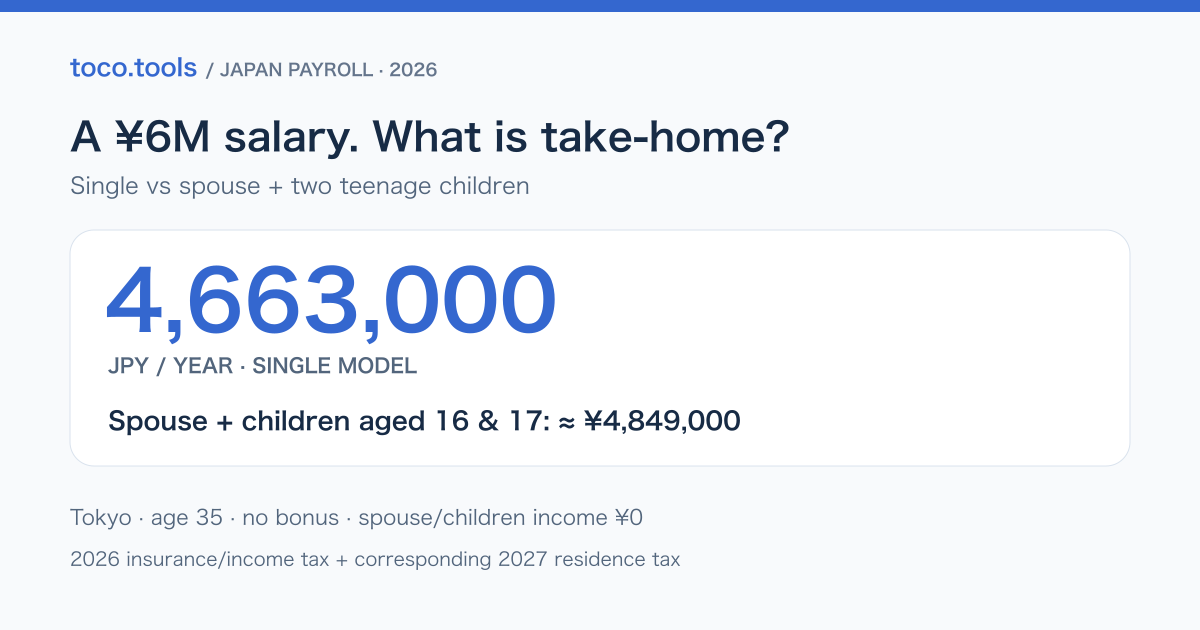
Employer spending, gross salary and personal take-home pay are three different amounts. Our salary and family take-home comparison explains the employee side, using calendar-year 2026 premium changes, final income tax and corresponding 2027 residence tax. Those conditions differ from the annualized insurance model above.
Sources and rates checked November 8, 2026. Future rate changes, partial-year employment, leave exemptions, officers, other insurers and in-kind wages are outside this model.