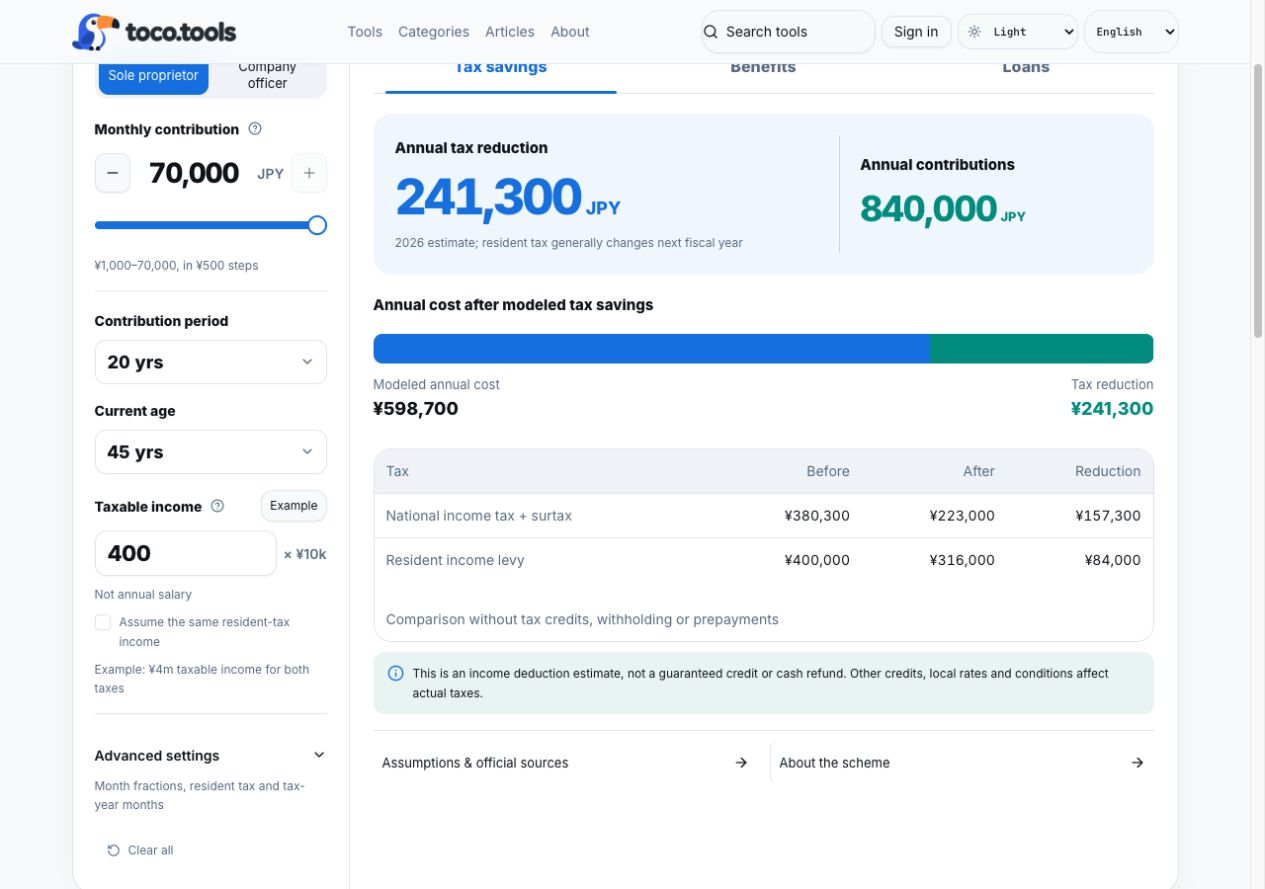

iDeCo can reduce your current tax bill while you build assets for retirement. In the example below, an employee with ¥3 million of taxable income who pays ¥276,000 a year could reduce income and resident taxes by about ¥55,800 annually. Consider both the future balance and how withdrawals will be taxed.
A tax return refunds income tax you have overpaid
The full contribution actually paid during the year qualifies for Japan's small enterprise mutual aid contribution deduction. An employee paying from a personal bank account can claim it through year-end adjustment or an income-tax return. National Tax Agency: contribution deduction
If year-end adjustment already included your contributions, filing them again does not create another refund. If they were missed, check your payment certificate or other accepted documentation and make a refund claim. With employer remittance through payroll, your employer includes the contributions in payroll and year-end adjustment. Official iDeCo procedures
An income-tax refund is limited to tax already paid through withholding or similar payments. Other credits, including the housing loan tax credit, can also change the actual benefit. Resident-tax savings normally reduce the following fiscal year's bill; they are separate from an income-tax refund. NTA: refund claims, how resident tax works
Estimated savings by taxable income
The first column is not gross annual salary. It is income-tax taxable income before the iDeCo deduction: salary after the employment income deduction, basic deduction, social insurance deductions and other applicable deductions. The same salary can produce different taxable incomes depending on family circumstances and other deductions.
This example assumes an employee with no workplace pension who actually pays ¥23,000 twelve times in 2026, totaling ¥276,000.
| Taxable income before iDeCo | Income-tax reduction | Next-year resident-tax reduction | Annual total |
|---|---|---|---|
| ¥1 million | About ¥14,100 | About ¥27,600 | About ¥41,700 |
| ¥2 million | About ¥16,600 | About ¥27,600 | About ¥44,200 |
| ¥3 million | About ¥28,200 | About ¥27,600 | About ¥55,800 |
| ¥4 million | About ¥56,400 | About ¥27,600 | About ¥84,000 |
| ¥6 million | About ¥56,400 | About ¥27,600 | About ¥84,000 |
| ¥8 million | About ¥64,800 | About ¥27,600 | About ¥92,400 |
| ¥10 million | About ¥93,000 | About ¥27,600 | About ¥120,600 |
Estimates rounded to the nearest ¥100, holding other income and deductions constant. Housing and other tax credits, resident-tax adjustment deductions, local surtaxes and final tax rounding are excluded. Income tax is the difference before and after the deduction, including the 2026 reconstruction surtax of 2.1%. Resident tax uses an approximate 10% income-based rate; fixed charges are excluded.
At ¥2 million, the deduction reduces taxable income to ¥1.724 million, crossing the ¥1.95 million bracket boundary. Applying 10% to the entire contribution would overstate the income-tax reduction. NTA: income-tax rates
From 2027, a 1.1% reconstruction surtax and 1% defense surtax replace the 2.1% reconstruction surtax. Their combined rate on income tax remains 2.1%. NTA: surtax changes
Higher contribution limits start with December 2026 contributions
For an employee without a workplace pension, the monthly limit remains ¥23,000 through the November 2026 contribution. From the December contribution, it becomes ¥62,000. With a workplace pension, employer contributions and relevant pension equivalents share the limit, so ¥62,000 is not a separate iDeCo allowance for every employee. Ministry of Health, Labour and Welfare: reforms
The December contribution is debited in January 2027 and, for personal remittance, counts toward the 2027 deduction. Starting now does not let you deduct twelve monthly payments for 2026. Official iDeCo debit schedule
What could ¥23,000 a month become in 30 years?
This is a future investment illustration, separate from the 2026 tax table. Total contributions over 30 years are ¥8.28 million. The following balances deduct account fees and are before withdrawal tax.
| Assumed annual return | Balance after 30 years |
|---|---|
| 0% | About ¥8.21 million |
| 3% | About ¥13.20 million |
| 5% | About ¥18.59 million |
| 7% | About ¥26.66 million |
No initial assets; ¥23,000 contributed at each month-end; a constant effective annual return. This model applies the published rules from 2027 onward, with an initial ¥2,829 fee and ¥186 monthly throughout the 30 years. The monthly fee assumes a ¥0 operator fee and ¥66 trust-bank fee; account fees total ¥69,789. Fund expenses, inflation, withdrawal tax and benefit-payment fees are excluded. Tax savings are not added to the balance. Returns are calculation assumptions, not forecasts.
The National Pension Fund Association fee changes from ¥105 per contribution to ¥120 per month from the January 26, 2027 debit. Official fee change, fee components
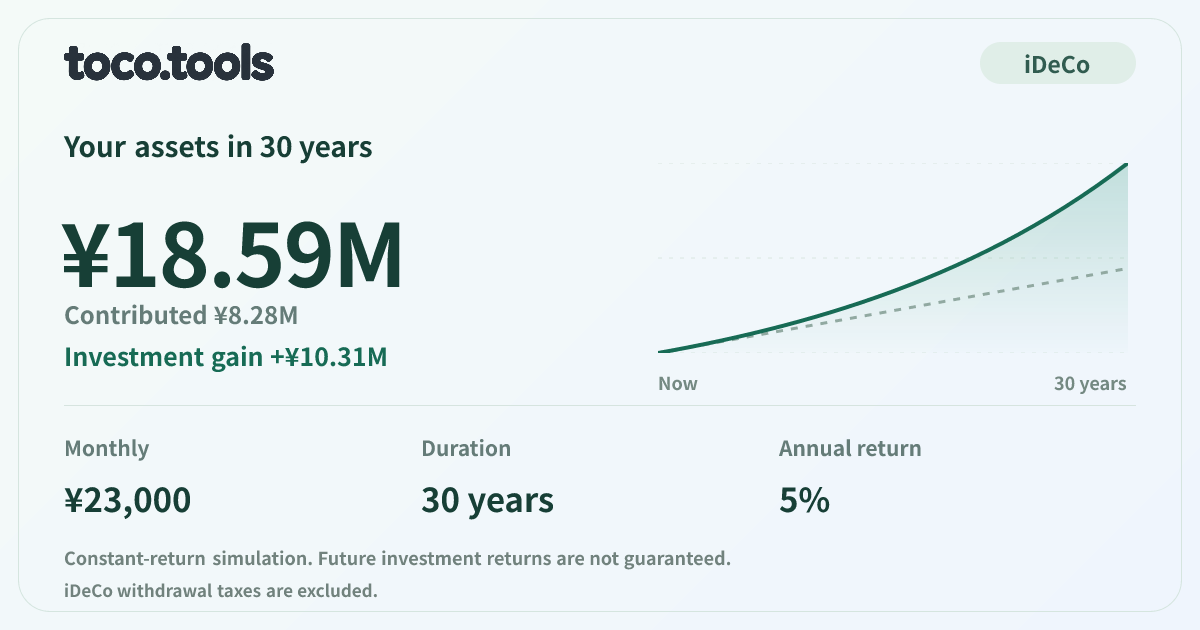
A share card using the simulator's calculation, after account fees and before withdrawal tax.
Open ¥23,000 monthly for 30 years at 5% to change the amount or duration. Its 10% income-tax setting corresponds to the ¥3 million taxable-income example above. The simulator keeps the selected tax rate constant, so its tax-saving estimate differs from a table row that crosses a tax bracket, such as ¥2 million.
For a lump sum, check your employer's retirement payment too
An iDeCo old-age lump sum qualifies for the retirement income deduction. Its qualifying years generally come from months in which contributions were paid, converted to years and rounded up for a partial year. Do not automatically add periods when you only held and managed the assets.
| Qualifying years | Retirement income deduction |
|---|---|
| Up to 20 | ¥400,000 × years, with an ¥800,000 minimum |
| More than 20 | ¥8 million + ¥700,000 × (years − 20) |
For an ordinary illustration with 30 contribution years and no adjustment for other retirement payments, the deduction is ¥15 million. A ¥20 million lump sum would produce ¥2.5 million of taxable retirement income: (¥20M − ¥15M) ÷ 2. This is the taxable amount, not the tax bill. Short qualifying periods and certain other cases have exceptions to the one-half calculation. NTA: retirement income, official iDeCo qualifying-period explanation
Receiving an employer retirement payment in the same year involves aggregation and related calculations. Different years can also require an adjustment where the qualifying periods overlap:
- iDeCo first: for a DC old-age lump sum received on or after January 1, 2026, check whether it falls within the nine calendar years preceding the later employer retirement payment's year.
- Employer payment first: when later receiving the DC old-age lump sum, check retirement payments in the preceding nineteen calendar years.
Spacing payments apart does not guarantee two full deductions. Earlier payment amounts and overlapping periods also matter. NTA: overlapping retirement deductions
Submit the retirement income declaration to the payer before receiving the lump sum. Without it, 20.42% of the gross payment is withheld and an income-tax return is used to settle the amount. That withholding rate is not everyone's final tax rate.
Pension withdrawals share a deduction with public pensions
Annuity-style iDeCo benefits are miscellaneous income from public pensions. They are combined with national, employees' and other qualifying pensions before applying the public pension deduction. iDeCo does not receive a separate deduction of its own. Age, total pension receipts and other income affect the calculation. NTA: public pension taxation, Japan Pension Service: covered pensions
Additional pension income may also affect National Health Insurance and long-term care insurance premiums. Compare withdrawal methods using take-home amounts after both tax and relevant premiums. National Health Insurance income calculation, long-term care income calculation
Start with an amount you can sustain
iDeCo assets generally cannot be withdrawn before age 60, and the earliest benefit age depends on qualifying participation periods and other conditions. Keep money for near-term needs available when deciding on contributions. MHLW: benefit conditions
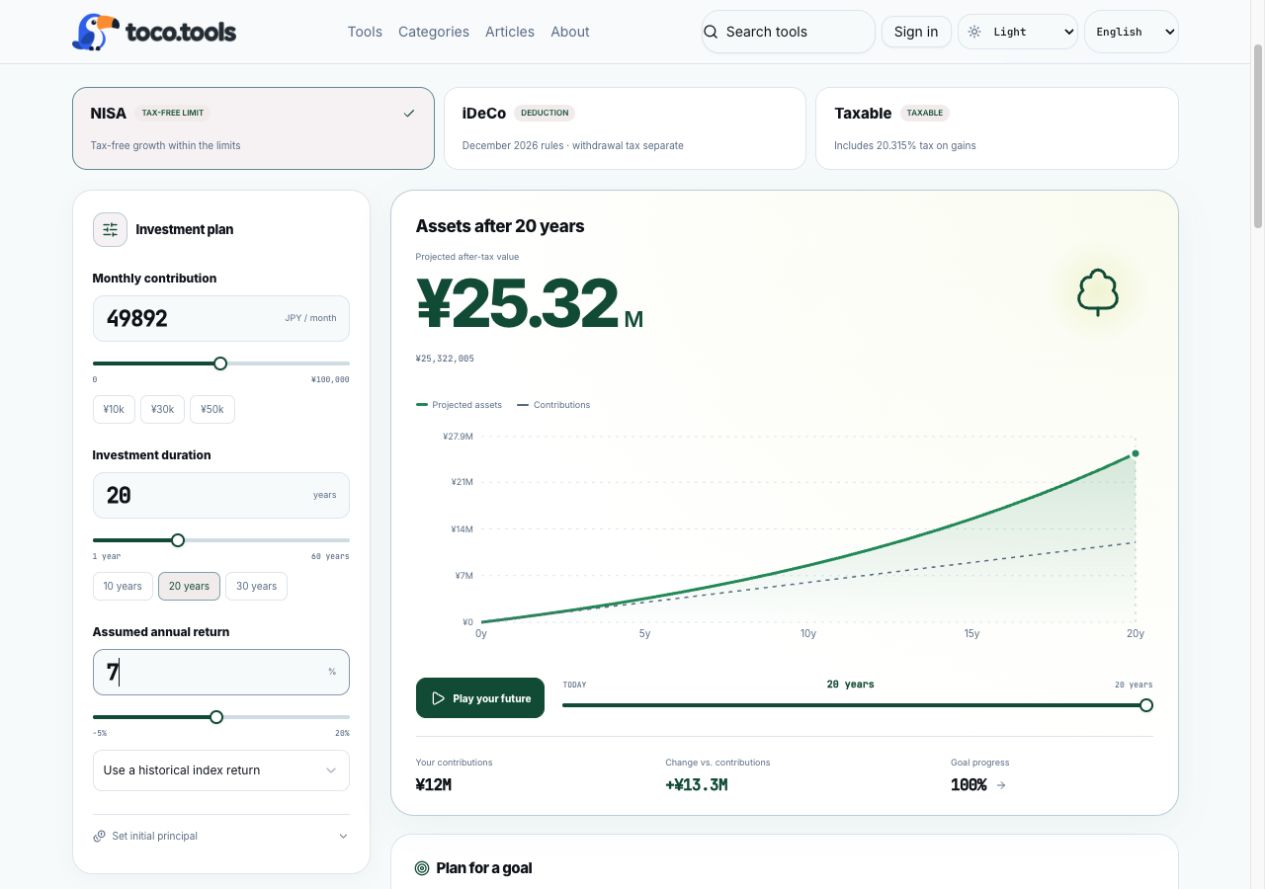
Begin by exploring your own contribution plan. For a simple explanation of how earlier gains can generate further gains, read the Rule of 72 and compounding.
Rules and tax treatment checked November 5, 2026. Forthcoming changes are distinguished from rules already in effect. The rules that apply when you eventually withdraw may change.