
How many years could it take for the money you already have to double? The Rule of 72 offers a quick estimate. It is a simple way to think about compounding through the time available to invest.
Divide 72 by the annual return
72 ÷ annual return (%) ≈ years for your money to double
At a 6% annual return, 72÷6 gives about 12 years. Enter 6 for 6%, rather than 0.06.
| Assumed annual return | Approximate time to double |
|---|---|
| 3% | 24 years |
| 5% | 14.4 years |
| 6% | 12 years |
| 8% | 9 years |
| 10% | 7.2 years |
This estimate assumes that returns on an existing lump sum are reinvested and the annual return stays constant. Taxes and expenses are excluded. Japan's Financial Services Agency also introduces the rule as a way to estimate the doubling time of a lump sum with compound growth. FSA: Rule of 72
From ¥1 million to about ¥2.01M, ¥4.05M and ¥8.15M
At an assumed annual return of 6%, ¥1 million earns ¥60,000 in its first year. The following year, the calculation starts with ¥1.06 million, including that earlier gain. Earlier returns can earn further returns: that is compounding.
Here is what the simulator calculates if you leave the investment to grow without adding more money.
| Investment period | Projected assets | Explore the same settings |
|---|---|---|
| 12 years | About ¥2.01 million | 12-year simulation |
| 24 years | About ¥4.05 million | 24-year simulation |
| 36 years | About ¥8.15 million | 36-year simulation |
A NISA-mode illustration with ¥1 million initially, no additional contributions and a constant effective annual return of 6%. Amounts are rounded to the nearest ¥10,000. Fund expenses, inflation and exchange-rate changes are excluded. The Rule of 72 is an approximation, so its estimate differs slightly from the calculated results.
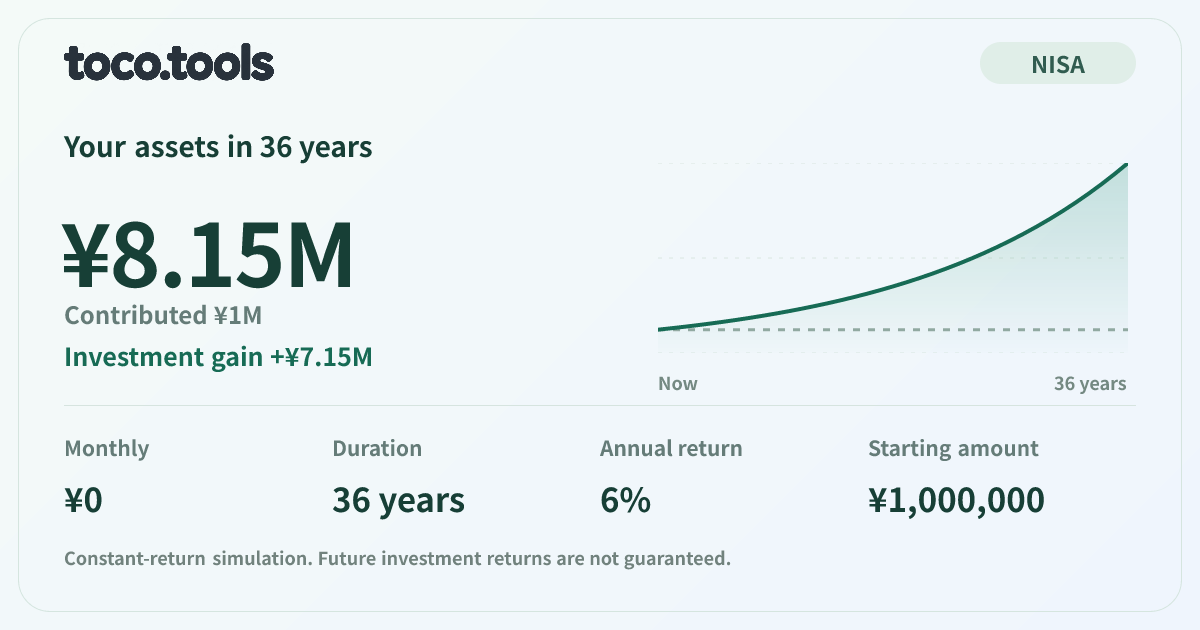
A share card generated with the same calculation as the simulator: ¥1 million initially, no additional contributions, 6% annually and 36 years.
The gain in the first 12 years is about ¥1.01 million. It is about ¥2.04 million in the next 12 years, then about ¥4.10 million in the following 12. Even without adding more money, reinvested gains increase the amount that can generate returns in later years.
Try your own monthly contribution
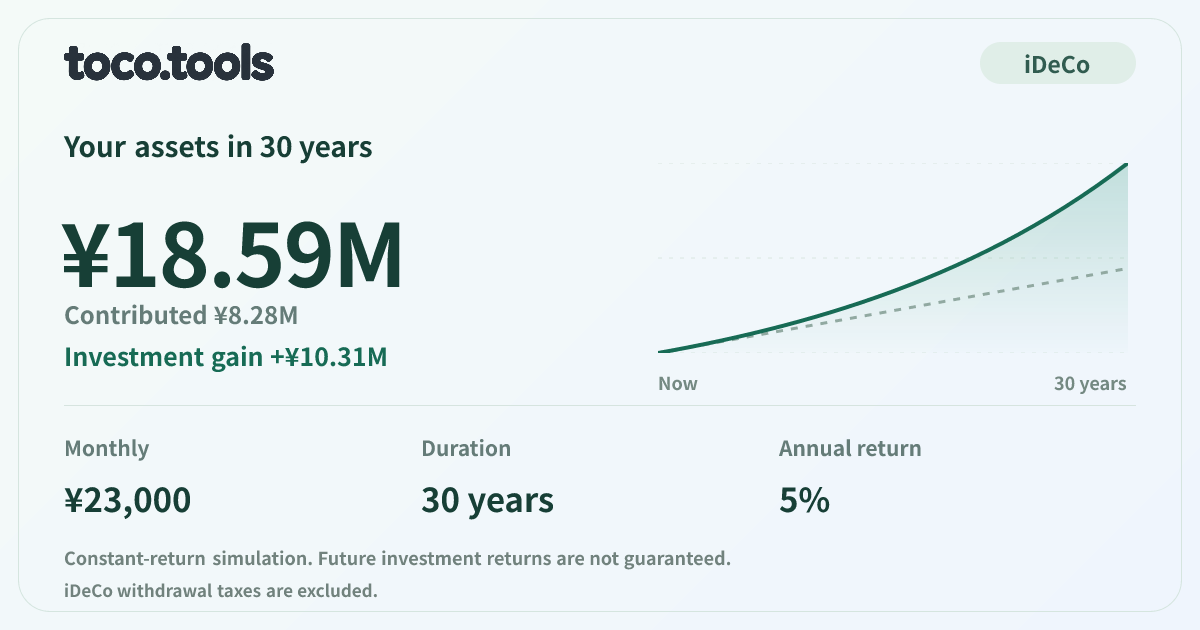
Time can help a small starting amount grow. You can also explore regular contributions without a large initial lump sum: start with ¥5,000 a month for 30 years at an assumed 5% annual return, then change the amount or duration.
Watch how the later part of the curve changes. For more contribution examples, read our article about aiming for ¥20 million in retirement with small regular investments. These returns are assumptions for comparison, not forecasts.
Frequently asked questions
Does 72 divided by the return also tell me when monthly contributions will double?
The rule estimates when an existing lump sum could double. Monthly contributions arrive at different times, so it does not mean that your total contributions will double over the same period. Use the simulator with your contribution, duration and annual return to explore that calculation.
Reference: U.S. SEC Investor.gov: compound interest and the Rule of 72.