
You do not need to find ¥20 million today. If retirement is 30 or 40 years away, you can think in terms of small monthly contributions and the time available to grow them.
For example, investing ¥10,000 a month for 40 years at an assumed annual return of 7% would produce about ¥24.72 million from contributions totaling ¥4.8 million. A goal that feels distant when you look only at your monthly budget can look different when you include time.
Future returns are still unknown. That is why it helps to try several assumptions and start with an amount you can keep contributing. Open the investment simulator with ¥10,000 a month, 40 years and a 7% annual return as we explore what small, regular contributions could make possible.
Does everyone need ¥20 million for retirement?
The discussion began with a 2019 report from Japan's Financial System Council. It described retired households consisting of a husband aged 65 or older and a wife aged 60 or older, with neither working. Their average monthly shortfall was about ¥50,000. Extending that shortfall over 20 to 30 years produced a total of roughly ¥13 million to ¥20 million.
This was a simple calculation based on an average household at the time. The report also explains that the amount needed varies with income, spending and lifestyle. You can use ¥20 million as a starting target, then adjust it to reflect your expected pension and housing costs. Japan Financial Services Agency: 2019 report, printed page 21
What could ¥10,000 a month become over 40 years?
First, compare investing ¥10,000 a month for 40 years with no initial lump sum. Total contributions are ¥4.8 million in every case.
| Assumed annual return | Balance after 40 years | Total contributions |
|---|---|---|
| 0% | ¥4.8 million | ¥4.8 million |
| 5% | About ¥14.83 million | ¥4.8 million |
| 7% | About ¥24.72 million | ¥4.8 million |
| 10% | About ¥55.50 million | ¥4.8 million |
These rates are assumptions for comparison. Each example uses NISA mode, starts with no initial investment, adds contributions at the end of each month and holds the annual rate constant. Balances are rounded to the nearest ¥10,000. Fund expenses, inflation and exchange-rate changes are excluded.
Compounding helps explain the difference: returns earned on your contributions are added to the money that continues to be invested. Over time, both your original contributions and earlier returns can generate further returns. Japan's Financial Services Agency also describes an approach that combines small regular investments, a long holding period and diversification. FSA: Basics of building assets
At the same assumed 7% annual return, ¥10,000 a month would become about ¥11.69 million after 30 years, compared with about ¥24.72 million after 40 years. The extra contributions total ¥1.2 million, but another decade of investing makes a much larger difference to the result. For someone starting in their twenties, having more time available is a valuable advantage.
Exploring long-term S&P 500 and NASDAQ-100 growth with small contributions
What kind of growth has occurred in the past? Here, we use long-term annualized returns published by the index providers as reference points.
The S&P 500 is a stock index covering 500 leading large U.S. companies. According to S&P Dow Jones Indices, its annualized return including dividends was approximately 10% from its launch on March 4, 1957, through the end of June 2025. Official S&P 500 brochure, page 5
What if that same approximate 10% annual rate continued for the next 40 years? Contributing ¥5,000 a month would produce about ¥27.75 million in this calculation, from total contributions of ¥2.4 million.
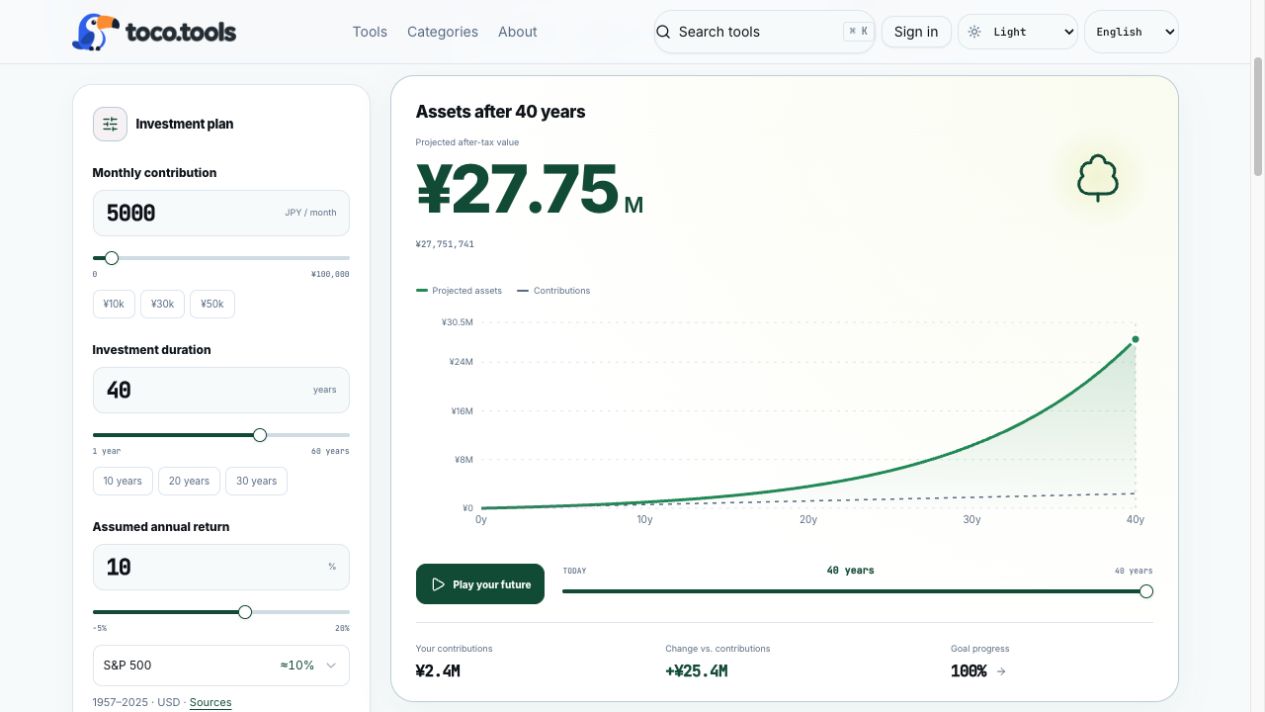
An illustration assuming ¥5,000 a month for 40 years at a constant annual return of 10%, using the S&P 500's approximate historical long-term annualized return as a reference. It does not recreate the historical outcome of those monthly investments.
Explore ¥5,000 a month for 40 years at 10% in the simulator
The NASDAQ-100 tracks large non-financial companies listed on Nasdaq. Nasdaq's official article reports a compound annual return of 14.25% from the index's launch on January 31, 1985, through the end of 2024. Nasdaq's official 40th anniversary article
In an optimistic scenario that assumes this high growth continues, even ¥5,000 a month for 30 years would produce about ¥23.92 million. Total contributions would be ¥1.8 million.
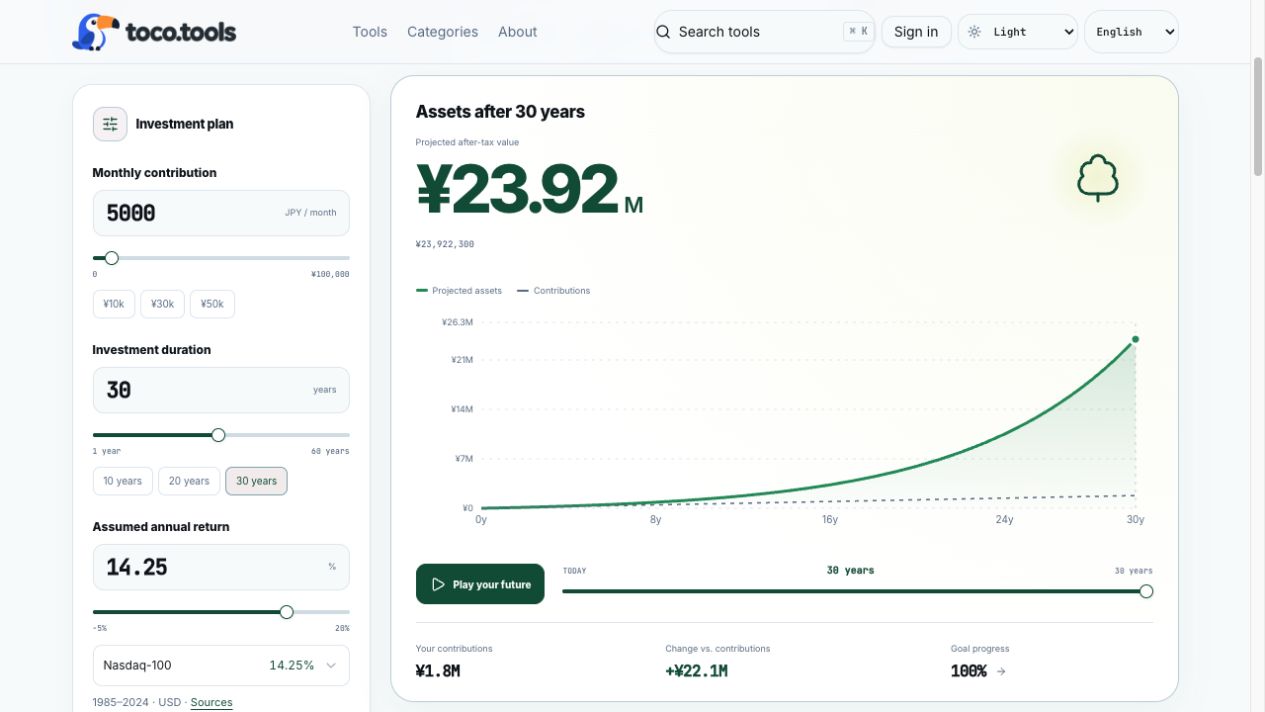
An optimistic illustration applying the NASDAQ-100's historical compound annual return of 14.25% to another 30 years. This is not an estimate of future returns.
Explore ¥5,000 a month for 30 years at 14.25% in the simulator
Both historical figures are for U.S. dollar-denominated indexes. Exchange rates and expenses also affect the returns of investment funds bought in yen, so their results will differ from the yen amounts above. The measurement periods and dividend treatment also differ, so these two rates alone cannot establish which index is better. Nasdaq's source article does not specify dividend treatment for the 14.25% figure, so we do not describe it as including dividends.
Actual markets do not grow along the smooth curves in these images. Some years are positive, others are negative, and you can lose part of the money you invested. Still, historical long-term growth offers one reference point when considering what a small start could become. When making a plan, return to the 5% and 7% assumptions and compare those results too.
How much would you need to contribute each month to aim for ¥20 million?
The time available changes the monthly amount needed for the same target. The figures below start with no initial lump sum and round the monthly contribution required to reach ¥20 million up to the next ¥100.
| Contribution period | Assuming 5% a year | Assuming 7% a year | Assuming 10% a year |
|---|---|---|---|
| 20 years | ¥49,300 a month | ¥39,500 a month | ¥27,900 a month |
| 30 years | ¥24,600 a month | ¥17,200 a month | ¥9,700 a month |
| 40 years | ¥13,500 a month | ¥8,100 a month | ¥3,700 a month |
At an assumed 7% annual return, the monthly amount is ¥8,100 over 40 years or ¥17,200 over 30 years. Starting earlier could help reduce the amount you need to set aside each month.
You do not have to contribute the amount in the table from day one. You could start with ¥3,000 or ¥5,000 a month, learn how to keep it going, and review the amount when your budget allows. Keep savings for near-term spending and unexpected expenses, and look for a contribution you can sustain. The ¥20 million target is a nominal amount at the future date. Inflation is excluded, so review the target as prices change.
Use the simulator to explore your own plan
Start by opening ¥5,000 a month for 40 years at a 5% annual return, then try these steps.
- Change the monthly contribution. Enter an amount that seems manageable within your current budget.
- Change the investment period. For example, age 25 to 65 gives you 40 years, while age 35 to 65 gives you 30 years.
- Change the annual return. Compare 5%, 7% and 10% to see how much the result changes.
- Change the target. Use ¥20 million as a starting point and adjust it to what you expect to need.
NISA is Japan's system for tax-free investment gains on eligible products. For adults, the annual allowance for the regular investment allocation is ¥1.2 million. The total tax-free holding allowance, combined with the growth investment allocation, is ¥18 million. Allowances are measured by purchase cost, so an investment balance growing beyond ¥20 million is different from exceeding the allowance. FSA: Understanding NISA
The examples in this article use a simplified NISA-mode calculation. The simulator models the combined allowance and does not determine whether an individual product is eligible.
You may not be able to predict the final amount precisely, but you can explore the contribution and time available to you today. Try replacing the example numbers with your own. Finding a manageable way to start small can turn retirement worries into something you can prepare for now.
You can share a plan you've explored as a URL or image. See how to share it.
Frequently asked questions
Is investing ¥5,000 a month worthwhile?
Yes. Your contributions would total ¥2.4 million over 40 years. At an assumed annual return of 7%, the final amount would be about ¥12.36 million. Even with a small amount, building a regular habit and giving it time can make a difference.
Will the S&P 500 keep returning 10% a year?
Its future return is unknown. The approximate 10% figure is a U.S. dollar-denominated historical result including dividends over a particular period. It does not mean the index rose by 10% every year. Compare different return assumptions in the simulator.
Can I aim for ¥20 million when NISA's allowance is ¥18 million?
The ¥18 million allowance is measured by the total purchase cost. It is not a cap on the value of your investments including growth, so purchases within the allowance can grow beyond ¥20 million.
Is it too late to start in my thirties?
You may still have a long contribution period available. For example, age 35 to 65 gives you 30 years. Enter your existing savings, monthly contribution and investment period to explore a plan you can keep up.