
A retail JGB's interest rate minus the loan rate is not, by itself, your profit. The November 2026 fixed five-year issue pays an annual 1.7291645% after ordinary interest tax, above the Small Enterprise Mutual Aid general-loan rate of 1.5%. But redeeming after the first year triggers an adjustment based on two coupon payments. Your loan may also fall due before the bond can be redeemed.
Whether this loan may be used to buy the bond must be checked first. This article tests the claimed spread against official terms; it does not establish that investment use is permitted. Rules and issue terms were checked on November 8, 2026.
Check the permitted use and the repayment obligation first
SMRJ's general-loan terms list business working capital, other business-related funds and living expenses as permitted uses. We did not find an explicit statement in the reviewed public materials authorizing ordinary securities investment. Permission to use a loan for living expenses does not establish permission to buy JGBs. Describe the intended transaction to SMRJ and your registered lending institution and confirm its treatment.
This is a loan with an obligation to repay, within a limit calculated from paid mutual-aid contributions. It is not a withdrawal of those contributions. The eligibility FAQ includes at least 12 paid contribution months, excluding prepaid months, by the relevant eligibility assessment.
| Condition relevant to a ¥1 million loan | Official rule |
|---|---|
| General-loan interest rate | 1.5% a year |
| Available term at ¥1 million or less | Six or twelve months |
| Twelve-month principal repayment | One payment at the deadline |
| Interest payment | Paid in advance when borrowing |
| Twelve-month illustration | ¥15,000 interest; ¥985,000 available after interest |
Source: SMRJ's loan overview. Our example assumes a notified limit of at least ¥1 million and no existing borrowing. Check the actual repayment date on the loan contract. The calculations below exclude administrative expenses such as any required revenue stamp; prepaid interest is not necessarily the transaction's only cost.
What do the November 2026 retail JGBs pay?
These are the MOF's terms as of November 6, 2026. Subscriptions run November 9–30, 2026, with issuance on December 15, 2026. Bond interest does not start on the subscription date. Official offering table
| Product / issue | Annual rate before tax | Annual rate after tax | Rate period |
|---|---|---|---|
| Floating 10-year / 200 | 1.85% | 1.4741725% | Initial six-month rate; resets every six months |
| Fixed 5-year / 188 | 2.17% | 1.7291645% | Issue rate fixed until maturity |
| Fixed 3-year / 198 | 1.94% | 1.5458890% | Issue rate fixed until maturity |
After-tax rates assume the ordinary combined interest-tax rate of 20.315%. Special tax exemptions and offsets against other transactions are excluded. National government bonds fall within the specified public-bond interest rules. NTA: interest income
The floating ten-year issue's 1.85% is an annualized rate applying to its first six months, not a rate locked in for ten years. Fixed five- and three-year bonds keep their issue rate until maturity; a newly offered bond next month need not carry the same rate. See the MOF's product terms for floating ten-year, fixed five-year and fixed three-year bonds.
Why an after-tax rate above 1.5% is insufficient
There is a one-year lock and an early-redemption adjustment
All three products normally cannot be redeemed before the second coupon date, one year after issuance. Exceptions include the holder's death and damage from a major natural disaster covered by the Disaster Relief Act. A loan coming due is not one of those exceptions. MOF early-redemption FAQ
For ordinary early redemption:
Redemption proceeds = face value + accrued-interest equivalent − early-redemption adjustment.
Adjustment = the pre-tax equivalent of the most recent two coupons × 0.79685.
Source: MOF fixed five-year terms. Special calculations apply to certain issues where an initial interest adjustment was paid at purchase, and to exceptional redemptions during the lock period. Our benchmark uses a purchase at issuance, two full half-year coupons and redemption on the second coupon date.
Since 0.79685 equals 1 minus 20.315%, the adjustment in this benchmark is approximately equal to the two coupons received after tax. Tax rounding, accrued days and tax-loss offsets can change the outcome. This is not a claim that every redemption after a year produces precisely zero bond interest.
A ¥1 million loan buys ¥980,000 of bonds
To isolate the cash amounts, first use a timing-stripped benchmark: assume borrowing and bond issuance occur together, followed by repayment one year later. This removes the subscription-to-issuance wait and the redemption settlement delay. It is not an executable promise to redeem and repay on the same day. A dated scenario follows below.
Assume a twelve-month general loan at 1.5% and fixed five-year issue 188 at 2.17%. Use ordinary 20.315% interest tax, retain the coupons in cash and do not reinvest them. Initially exclude tax-loss offsets, accrued days, fractional-yen tax rounding, account fees and loan administration expenses.
Allocate the cash, including the remainder
| Initial allocation | Amount |
|---|---|
| Loan principal | ¥1,000,000 |
| Prepaid interest | −¥15,000 |
| Cash available after interest | ¥985,000 |
| Bond face value, in ¥10,000 units | ¥980,000 |
| Uninvested cash retained | ¥5,000 |
Retail JGBs are purchased in face-value units of ¥10,000. With ¥985,000 available, the allocation is therefore ¥980,000 in bonds plus ¥5,000 cash. Dropping that remainder would overstate the loss. MOF fixed five-year product terms
Count coupons, redemption and repayment
The two pre-tax coupons total ¥980,000 × 2.17% = ¥21,266. After tax, ¥21,266 × 0.79685 is approximately ¥16,946.
| Cash through the first year | Approximate amount |
|---|---|
| Two coupons already received, after tax | +¥16,946 |
| Redemption adjustment: ¥21,266 × 0.79685 | −¥16,946 |
| Bond redemption proceeds: ¥980,000 less adjustment | ¥963,054 |
| Retained coupons + redemption proceeds + ¥5,000 cash | ¥985,000 |
| Repayment of loan principal | −¥1,000,000 |
| Net result without a tax-loss offset | −¥15,000 |
Thus ¥963,054 + ¥16,946 + ¥5,000 − ¥1,000,000 ≈ −¥15,000. Prepaid interest has already reduced the cash available at the start. Do not deduct it a second time at the end.
Ignoring redemption would instead give ¥16,946 of after-tax coupons minus ¥15,000 loan interest: an apparent ¥1,946 profit. That calculation omits the adjustment required to release the bond principal for repayment.
A tax-loss offset is a separate, conditional calculation
The early-redemption adjustment can be treated as a disposal loss and, subject to the applicable rules, offset against eligible listed-security interest, dividends or disposal gains. See Mizuho Bank's product terms and the NTA's loss-offset guidance. Paying an adjustment does not automatically generate a tax refund equal to that adjustment.
Suppose both coupons and redemption fall in the same tax year, there are no competing losses and the full adjustment can be offset against eligible income in that year. Before rounding, the disposal loss is approximately ¥16,945.8121, not the gross coupons of ¥21,266. The modeled tax reduction is ¥16,945.8121 × 20.315% ≈ ¥3,443. Adding it to the earlier example gives a result of approximately −¥11,557.
That conditional example still produces a loss, and the refund need not arrive by the loan repayment date. Account type, transactions across institutions, filing choices and other gains or losses affect the process and outcome. Keep this scenario separate from the no-offset table.
With actual issue dates, repayment can come first
The following is a hypothetical borrowing contract and cash-flow scenario. The bond subscription, issue and scheduled coupon dates come from the official fixed five-year issue 188 terms. Assume the borrowing is authorized and that both the loan and subscription can be completed on November 9.
| Date | Event | Cash-flow consequence |
|---|---|---|
| November 9, 2026 | Borrow ¥1 million for twelve months and subscribe to the bond; assumed | Pay interest in advance and provide the purchase funds |
| December 15, 2026 | Official bond issue date | The bond holding period starts here |
| June 15, 2027 | First coupon date | A half-year coupon arrives; principal remains locked |
| November 9, 2027 | Assumed contractual loan repayment date | The bond still cannot normally be redeemed; repayment needs another source |
| December 15, 2027 | Second coupon date; normal redemption lock ends | Redemption availability does not mean same-day cash |
| December 17, 2027 | Illustrative Mizuho settlement if the trade is agreed on December 15 | Three business days counting the trade date; confirm actual acceptance |
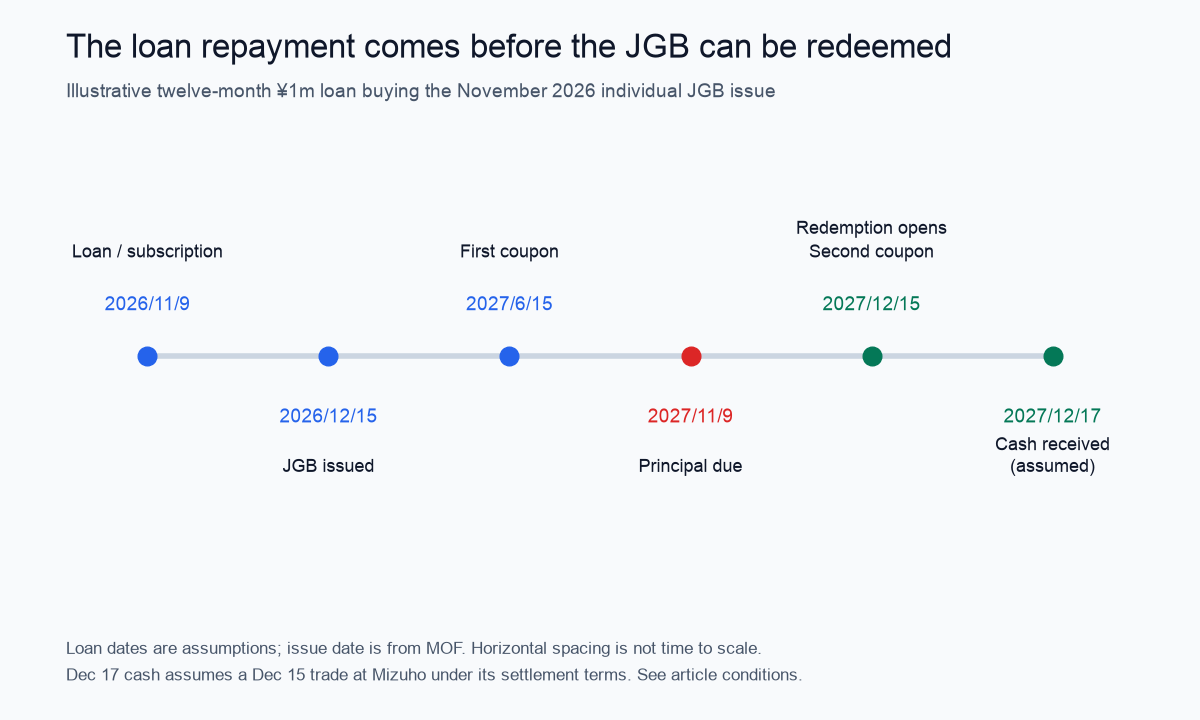
Subscription, issuance, coupon payments, a redemption request, trade execution, cash settlement and loan repayment are different events. Mizuho says it generally collects the purchase funds at subscription and pays no interest on that subscription deposit before issuance. Bank product terms
Settlement timing is not identical at every institution. The MOF FAQ says approximately three business days counting the request date and directs customers to the institution. Mizuho's FAQ specifies three business days counting the execution date. It also excludes execution during the four business days immediately before a coupon date, among other restricted periods. December 17 assumes execution on Wednesday, December 15, followed by two business days.
Eligible for redemption after one year does not mean available for a twelve-month loan repayment. In this scenario, the redemption lock itself extends beyond repayment. Repaying from your own money first is possible only if that separate funding is available and included in the plan.
Holding a JGB with your own funds is a different decision
If you buy the same ¥980,000 face value of fixed five-year issue 188 with your own funds and hold it to December 15, 2031, there is no early-redemption adjustment. Assuming the current tax rate continues, its five years of coupons total approximately ¥84,729 after tax, without reinvestment. The ¥980,000 face value is repaid at maturity. Official issue terms
| Question | Bond bought with own funds | Bond bought with a twelve-month loan |
|---|---|---|
| Loan interest | None | ¥15,000 prepaid in this example |
| Interim funding requirement | Your own spending plans | Loan principal comes due before bond maturity |
| Early-redemption adjustment | None if held to maturity | Applies if an early redemption is needed for repayment |
| Future floating ten-year rate | Resets every six months | Bond resets plus any future refinancing conditions |
The five-year own-funds example and the one-year borrowing example have different durations and funding requirements. They are not a like-for-like performance ranking. The bond's principal-redemption features do not guarantee a profit after financing costs and liquidity needs.
Can a longer loan or repeated refinancing solve it?
SMRJ offers a same-amount refinancing procedure. It requires a new loan contract and prepaid interest. It is not automatic renewal or a guarantee that the same terms remain available in future years. Assuming repeated refinancing until the bond matures introduces an additional funding assumption; the repayment plan must also cover a case without refinancing.
Longer general-loan terms have minimum borrowing amounts: at least ¥1.05 million for 24 months, ¥3.05 million for 36 months and ¥5.05 million for 60 months. Contracts of 24, 36 or 60 months require equal principal repayments every six months. SMRJ's term and repayment table
You therefore cannot simply select a five-year loan for ¥1 million and leave the entire borrowed amount in bonds. A longer qualifying loan still requires interim principal repayments. Specify whether these come from other income or partial bond redemptions. As repayments reduce the outstanding loan, the borrowed principal remaining available for investment is not constant. A twenty-year compound-return model using a constant spread leaves out these repayments, redemptions and new borrowing decisions.
The mutual-aid contribution deduction is also a separate benefit: it applies to contributions paid during the year. If the same contributions are paid in both the borrowing and no-borrowing scenarios, the deduction belongs to both. Adding the already-counted tax saving again as profit from buying bonds with borrowed money overstates the incremental benefit.
How to check your own dates and amounts
Confirm the intended use, available loan limit, contractual repayment date, costs and refinancing procedure with SMRJ and the lending institution. Then ask the bond provider when purchase funds are required, when the bond is issued, when redemption is allowed and when proceeds reach the account. Put the dates together and check cash available before the loan deadline.
Use the Loan tab in the toco.tools Small Enterprise Mutual Aid calculator to check prepaid interest and available cash. Use the MOF retail JGB simulator for coupons and redemption adjustments by product, issue and face value. Adding the two calculators' amounts alone will not identify a date mismatch; use the loan repayment schedule alongside them.
For the decision to contribute in the first place, see mutual aid versus NISA. For borrowing to buy assets with market-price fluctuations, see the borrowed-investment checklist. Early cancellation and tax when receiving mutual-aid benefits involve separate conditions.
In this ¥1 million example, permitted use needs confirmation, and the apparent annual spread omits both the redemption adjustment and repayment timing. A JGB held with your own money until maturity does not establish a guaranteed profit from borrowing to buy it.